Intelligence.
From static repositories to living, self-optimizing frameworks — AI and automation as the connective tissue between strategy and execution.
AI is not a co-pilot. It is the governance engine.
A traditional design system begins decaying the moment it is published. It relies on manual updates, constant policing, and fragile handoffs — a structurally unsustainable model at the scale of complex digital ecosystems.
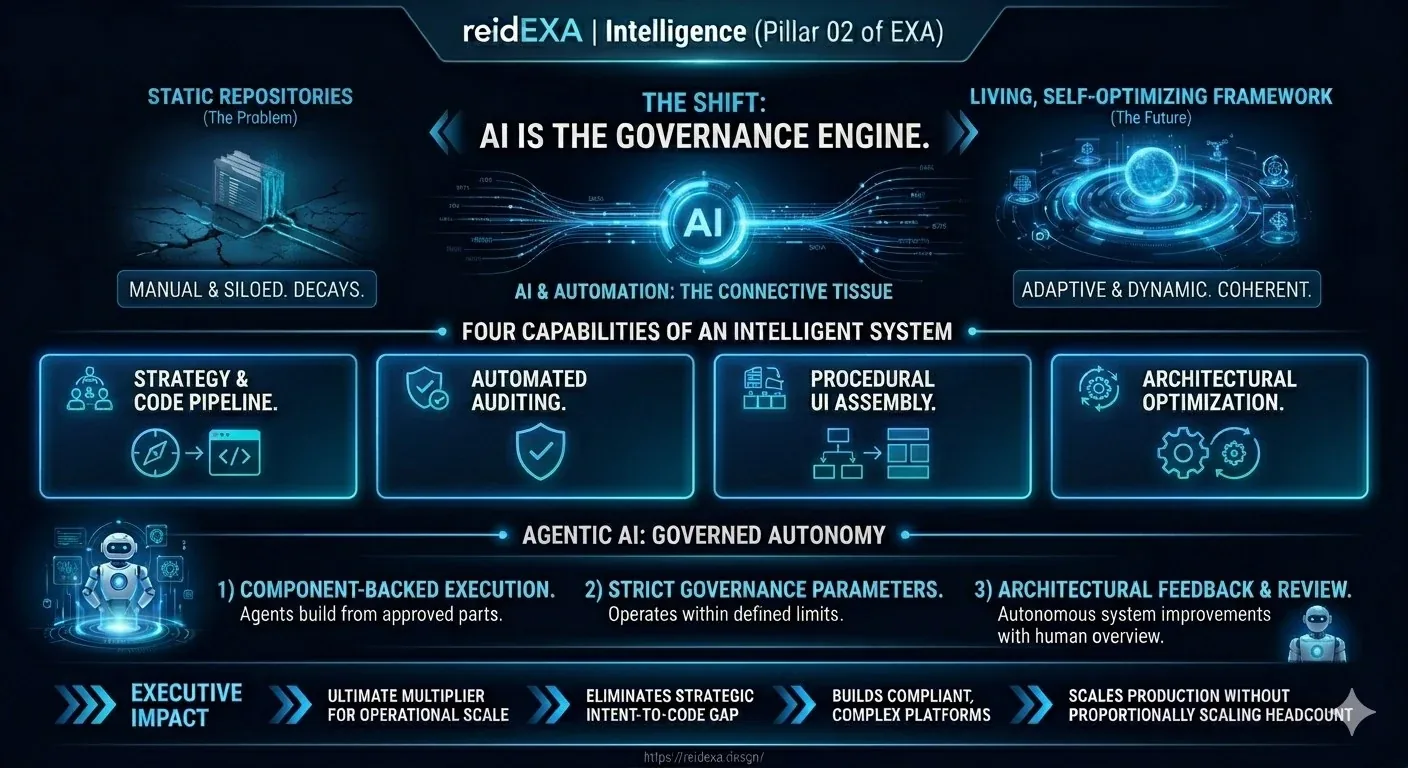
Intelligent Systems represent the paradigm shift at the core of EXA. This is the evolution from a static library of parts to a dynamic, living ecosystem where AI and automation act as the connective tissue between strategy and execution.
In EXA, intelligent technologies are not just used as a co-pilot for creating assets — they are the underlying engine for governance, continuous translation, and structural evolution at scale. This reframing is what allows enterprise architecture to remain coherent as it scales across dozens of product teams and entirely different tech stacks.
The Design System
- Documents what exists — a record of components. Cannot enforce what should not be done.
- Human governance only — design reviews and Slack channels, all requiring humans to catch humans, at scale, under pressure.
- Entropy always wins — it decays from the moment it ships, with no self-governance mechanism.
- AI multiplies the failure — agents execute against a fractured spec at machine speed, with total confidence.
Infrastructure of Intent
- Encodes why — not just what components look like, but the logic governing why they behave as they do.
- Invalid states structurally impossible — like a compiler catching a type error, before it ever reaches production.
- Continuous learning — real telemetry on how the architecture is used; overrides become structural signal.
- AI executes, not guesses — agents pull from versioned logic. Governed Autonomy at machine speed.
AI does not need pictures. It needs logic.
Four capabilities of an Intelligent System.
Each capability is a distinct function of the system — together they transform design from a managed artifact into a self-maintaining infrastructure.
Bridging Strategy and Implementation
The historic bottleneck in enterprise design is the translation of visual intent into functional reality. Intelligent Systems close this gap by directly connecting semantic design variables and tokens to AI-assisted development environments. This connective tissue is the Semantic Layer — the machine-readable specification sitting between visual design and compiled code, encoding not just what things look like but why they must be that way. The system translates the architect's strategic rules into context-aware logic, creating an unbroken thread from the initial UI concept straight through to the compiled code.
Automated Governance & Compliance Auditing
Managing a global enterprise UI library manually is unsustainable. Intelligent Systems deploy continuous, AI-driven auditing to enforce EXA rules. As components are utilized across disparate product teams, the system automatically verifies strict adherence to WCAG accessibility standards, reusable UI patterns, and brand logic — flagging deviations and preventing technical and design debt before it merges into the ecosystem.
Context-Aware Assembly
Moving beyond manually dragging and dropping components, Intelligent Systems enable teams to assemble complex, data-heavy layouts procedurally. By understanding the established EXA rules, the system can interpret context — knowing when to deploy a high-density enterprise data table versus a streamlined workflow — and automatically generate the correct structural patterns with the appropriate front-end architecture.
The Continuous Learning Loop
An Intelligent System learns from its own deployment. By analyzing telemetry on how components are actually used by developers and product teams globally, it identifies friction points. If a specific structural pattern is constantly being detached or overridden, the system highlights this inefficiency — allowing the central EXA team to refine and optimize the root architecture.
Agentic AI — governed autonomy at scale.
The natural extension of an Intelligent System: machine agents that execute against the architecture itself.
The next evolution of enterprise software development is not merely AI-assisted — it is agentic.
In traditional environments, AI is used as a co-pilot to generate isolated blocks of code or visual assets — often resulting in fractured, off-brand, and non-compliant outputs. EXA fundamentally changes this dynamic.
Within the EXA framework, agentic solutions operate inside a strictly governed, intelligent system. Agents do not guess. They execute against meticulously defined semantic variables, design tokens, and atomic rules — building, testing, and deploying enterprise-grade applications at unprecedented velocity, without ever breaching the established architectural boundaries. Those boundaries are written down as the Agentic Constitution — a machine-readable constraint file an agent executes against, not a Figma file an engineer has to interpret.
Component-Backed Execution
Inside a certified component library, agents assemble. They never invent.
Moving beyond unstructured "vibe coding," agentic solutions within EXA assemble actual, pre-approved components — never inventing a button, never freelancing a layout, wherever the surface is built from a pre-enumerated set of certified states. Agents pull directly from the centralized design system to generate functional, WCAG-compliant front-end code.
Governed Autonomy
Strict parameters, not free-form generation.
AI agents operate inside strict, mathematically defined parameters. The EXA framework provides the logic — spacing, typography, data-density rules, and interaction models — ensuring machine-generated output is indistinguishable from human-architected quality.
Continuous Architectural Optimization
The system improves itself.
Agentic systems monitor real-world telemetry across the global digital ecosystem. If an agent detects continuous friction or detachment of a specific component, it autonomously flags the inefficiency and suggests a structural update to the core EXA framework.
The Shift to Reviewer Interfaces
Humans validate. Agents execute.
As agents handle the heavy lifting of backend workflows and UI assembly, EXA defines the new human–machine interaction model. The architecture shifts from operator interfaces to reviewer interfaces — allowing human overseers to rapidly validate, modify, or approve agentic outputs with absolute clarity. This interaction model — and the governing function that runs it — is developed in full in Series Three, The Reviewer's Interface, and formalized as the Enterprise Experience Architect on the EXA Standard.
The four capabilities above assume the surface has already been enumerated — an agent assembling from a certified library it can point to. The Generative Frontier covers the harder case: an agent composing structure live, from a bounded grammar certified as a space at design time, not a list of pre-approved parts. The governing terms are ratified — see Generative Envelope and the Invention/Assembly Boundary Test in the Standard. Article 1 is published: Nobody Reviewed the Screen. The Screen Was Still Governed.
Agentic AI is the ultimate multiplier for operational scale. By providing AI models with a rigorous, tokenized architectural foundation, EXA eliminates the gap between strategic intent and code generation — allowing organizations to deploy intelligent systems that build compliant, consistent, and highly complex internal platforms, scaling production capabilities without proportionally scaling headcount. This is where the Specification Economy becomes concrete: a governed Agentic Constitution produces one clean agent pass, while an ambiguous one generates the Retry Tax — the metered AI inference cost of agents looping against a gap the architect never closed. Call that failure mode the Retry Loop — visible, billed, already on the invoice.
What Governed Autonomy prevents in production.
The clearest proof of an Intelligent System isn't a velocity metric — it's the costly failure that becomes structurally impossible to ship. The Retry Loop shows up on an invoice. What follows is its quieter twin — the Silent Render: no loop, no retry, no signal, until it's already shipped.
A health insurer. Four product squads, four member-eligibility views, one design system — and three of the four squads have detached from it, because the central component never encoded Medicaid redetermination states or dual-eligible status. When a CMS requirement changes, three teams update correctly. The fourth ships an eligibility view that renders a lapsed member as active — a claims liability, not a display bug. Under EXA, that state is impossible to ship: the display logic for every eligibility state lives in the Semantic Layer, the squads populate governed states instead of forking components, and the agent assembling the surface executes against the constitution rather than guessing. The architecture does not make the team faster at fixing the error. It makes the error structurally unshippable.
Read the full argument on Medium.
Five published pieces develop Governed Autonomy in full — the constitutional argument, the practicing architect's new deliverable, the boundary against Spec-Driven Development, and the governance mechanism that operationalizes it: the Logic-Review Gate and the Cultural Veto.
AI Doesn't Need a Better Design System. It Needs a Constitution.
How Governed Autonomy and the Semantic Layer replace governance-by-policing with an architecture that enforces itself at machine speed.
Read on Medium →The New Deliverable — Why Your Design Architect Writes Markdown
The Agentic Constitution, the Semantic Handoff, and the full toolchain that replaces screen-based handoffs with machine-readable governing logic.
Read on Medium →Spec-Driven Development Certifies the Code. Who Certifies the Consequence?
GitHub's Spec Kit and the SDD discipline certify that the code is built right — but an engineering constitution has no concept of a lapsed member rendered active. The Agentic Constitution is the second, upstream document.
Read on Medium →Approval Is a Ceremony. Ratification Is an Authority.
Your org has a sign-off for the pixels and no sign-off for the logic. Before you can staff that gap, you have to build the gate. Here it is — and how it survives a hundred squads.
Read on Medium →Your Kill Switch Works. Nobody Has the Standing to Pull It.
A squad ships a "temporary" agent behavior to hit the quarter and never comes back. Two mechanisms govern what is already in the wild — one that can say no, and one that can say yes safely.
Read on Medium →